Monday, July 17, 2006

Hakarat ha-tov

Today I did something I've meant to do for a while.

As I was taking the subway back from a meeting in the city, a uniformed National Guardsman got on the train. When we got to my stop, I walked over to him and said, "thank you for what you do." He seemed kinda surprised, but he managed to say "thank you" and I walked out.

I don't know if it's the heightened tension in Israel, the fact that my dad's decided to become a volunteer policeman, or the fact that I had just come from meeting a group of individuals who embody the concept of service, but it felt like the right thing to do.

Hakarat ha-tov is something I don't take lightly. I will always be indebted to this country for having served as a haven for my grandparents and great-grandparents, for having enabled my parents to pursue educations and careers and for having provided my family and me with rights and opportunities of which our ancestors would never have dared dream.

My synagogue has adopted the custom of reciting both the prayer for the government and armed forces of the United States and that for Israel aloud and in unison. I've always been irritated by those who stand idly during the former and choose only to recite the latter. The mere existence of a robust Jewish community worshipping openly and freely in a democratic society is reason enough to give thanks for America.

The fact that America's armed forces rely solely on volunteers -- and that those volunteers do indeed step up for service -- is a marvellous testament to the spirit that drives this great nation.

Whether or not it's reshit tzmihat ge'ulatenu is irrelevant; at the very least, it's some of the sunshine, water and soil that is enabling the ge'ulah to grow and we ought never to forget the role America has played in the development and continued sustainability of Israel and the Jewish people.

Friday, July 14, 2006

The Three Weeks begin

The Three Weeks started early this year.

The thought hadn't really occurred to me until a friend of mine in Israel said something, but it's absolutely true.

I came in to work on Wednesday with a generally cheerful disposition, having read nothing more than that morning's free -- and outdated -- newspaper on the subway. When I walked into the office and people saw my obvious obliviousness, they told me what had happened. Obviously, I was upset. But it didn't really affect me.

This point was not lost on my friend in Israel when she called later that evening. She was concerned that I wasn't more upset. My father, after all, lives in Israel, my sister is visiting there, and all of my friends there are of army age or certainly candidates for reserve duty. Still, my mind was elsewhere -- I was speaking at an event, making last-minute arrangements. I couldn't think about it.

It wasn't until Avinu Malkenu at Minha on Thursday -- Shiv'ah-'Asar be-Tammuz -- that it hit me. As I stood in the back of my synagogue, I started reciting the verses silently. All of a sudden, I started relating everything I was saying to the situation on the ground.

Avinu malkenu, batel me'alenu kol gezerot kashot.

Avinu malkenu, batel mahshavot son'enu.

Avinu malkenu, hafer 'atzat oyvenu.


Avinu malkenu, kaleh kol tzar u-mastin me-alenu.

Avino malkenu, setom piyot mastinenu u-mekatregenu.

Avinu malkenu, kaleh dever ve-herev ve-ra'av u-shevi u-mashhit ve-'avon u-shemad mi-benei veritekha.

And so on.

I found myself thinking about the residents of the north, of the families of the dead and missing, of those whose whereabouts are yet unknown.

At the end of the tefillah, the rabbi came to the bimah and recited two chapters of Tehillim -- Psalms -- due to the current situation. As we read ch. 121, I found myself seeing more to that chapter than I ever had before.

The first verse embodies the speaker's anguish -- "I lift up my eyes unto the mountains; from whence shall my help come?" One can almost see the speaker looking anxiously towards the hills, wondering who will come to his aid.

"My help comes from Ado-nai, maker of heaven and earth," he tells himself, almost angrily. 'How could I ever have doubted Him?,' he asks himself.

The last six verses form a dialectic between personal and collective salvation. It is as if the speaker is trying to convince his audience that G-d's Providence extends to them as individuals, as well as to the entire nation of Israel

But most interesting, to me, is the progression inherent in the narrative. We see the speaker going from open anxiety to a sense of personal confidence that eventually allows him not only to seek comfort himself, but to comfort another individual ("He will not permit your foot to be moved") and, eventually, the entire Jewish people ("Behold, he who keeps Israel neither slumbers nor sleeps").

Personally, I found the recitation comforting and I saw in it a prayer.

May we draw the strength not only to comfort ourselves, but to support our brothers and sisters wherever they are and to strengthen the entire nation of Israel during this difficult time. And may we know the peace of G-d's watch over our goings and comings from now until forever.

Shabbat Shalom.

Tuesday, May 09, 2006

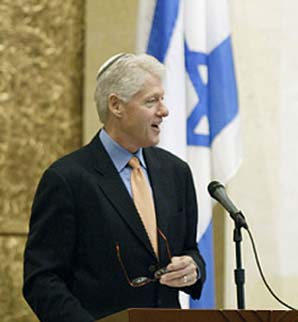
Celebrity kippa-wearer #2

Date: December 9, 2001.
Location: Kikar Zion, Jerusalem.
Occasion: Hanukkah in the Holy Land / terror solidarity trip.
Analysis: This is actually quite moving. We've got Pataki, Sharon, Giuliani and Rav Lau, with the middle men (no pun intended) engaging in a touching embrace as Pataki looks rather stern and Rav Lau looks suspiciously like Santa Claus. In any event, the charm (or irony) here is that Giuliani--like Dr. Clintonovich--is wearing a natural-looking s'rugie, while our distinguished former P.M. dons what appears to be a bar mitzvah guest yarmulke. It's a meaningful picture, all the same, replete with happiness, good cheer and perhaps a few extra percentage points in the Upper West Side. Ho ho ho.
Score: 10/10. Just because I love Giuliani.

Celebrity kippa-wearer #1


Date: October 2004.

Location: B'nai Torah Congregation, Boca Raton.

Occasion: Stumping for candidate Kerry.

Analysis: I mean, come on -- look at him! First, he's wearing a kippa s'ruga, as opposed to those silly polyester camping tents we tend to give those of our guests who we'd like to stand out. Second, he's got The Flag behind him. Third, he's quite clearly standing in front of an aron. Finally, he's holding his glasses just so. He looks like the kindly neighborhood professor who gives occasional Shabbat talks on the history of the Marranos or how Iggeret ha-Sh'mad has been interpreted over the ages or some such thing.

Score: 10/10. I'd welcome Dr. Clintonovich to my shul anytime.

Monday, May 08, 2006

One of the greatest Hillulei Hashem to come our way in a long time

So, I'm sitting in my apartment flipping through channels earlier this evening, trying desperately to find some productive way to procrastinate, when I see what seems to resemble the skyline of the Old City at twilight. Sure enough, that's what it is. I'm trying to remember what channel this is and whether I have any idea what I'm watching when the A&E logo shows up on the bottom-right of the screen, followed by a title I had to read twice: "Red Light Districts."

Over the course of the next twenty or so minutes, I went through all five of Kübler-Ross's stages of mourning, save the last.

For the first few seconds, I was in denial. "Maybe we're talking about 'red light' as in emergency. Maybe this is about terror or international crises." Nope. It was what it was, a rundown of Israel's burgeoning sex trade industry, casting the light of American cable television on one of Israel's ugliest and most shameful aspects.

Within minutes, I was seized with anger. "What the hell is wrong with that country?" I asked myself. Somehow, David Ben-Gurion's assertion that we'd know "we have become a normal country when Jewish thieves and Jewish prostitutes conduct their business in Hebrew" rang all too true.

Soon, I was bargaining. "Let them only show the lighter side of Israeli prostitution," I told myself, knowing full well that no such thing exists. And, as if in answer, the program went from bad to worse, with scenes of virtually naked women writhing on some stage in Tel Aviv, images of women being solicited by the drivers of old Subarus and a tour of a ditch filled with what must have been hundreds of used rubbers, in which a young woman had been found dead a week earlier. We were told the heartbreaking story of a young woman brought to Israel from Russia, who said she knew what she was being brought to do but whose friends thought they were coming to be dancers.

Inevitably, I sank into depression. Where have we gone wrong? How is it that in the land of the Jews, the Jewish, democractic state, human beings are being traded and treated as metaltelin -- mere objects -- over which other humans can exercise ugly proprietorship for a matter of shekalim? How is it that the people who brought the world ethical enlightenment as an or la-goyim are now importing young women to satisfy the basest of their desires? How is it that a land endowed with sanctity and beauty is allowing itself to be so crassly defiled?

I stopped short of acceptance. Thank G-d, we have organizations like the Israel Women's Network, which has encouraged and supported the work of the Knesset Committee of Inquiry established to deal with the issue. Thank G-d, we have activist parliamentarians like MK Zahava Gal-On, with whom I disagree on pretty much everything, but whose activism on this issue is a tribute--albeit a sad one--to Israel.

What remains is for us to take a long, hard look at ourselves and ponder how we can help these women extract themselves from their predicament and rehabilitate their lives while, at the same time, extracting ourselves from our collective descent into moral decadence and rehabilitating a society that has tolerated this practice for far too long.

Coming soon...

Celebrity kippa-wearers.

You're gonna love the way they look. I guarantee it.

Paradise Whenever

It's been a while since I last posted, for a variety of reasons (notable among them a holiday I like to call Paskha--erm--Passover), but I thought this would be an appropriate time to raise an issue that's become blessedly passe', but that still merits some discussion.

I refer, of course, to the film Paradise Now.

It's the heartwarming tale of two Palestinian best buddies -- Amin and Khaled -- who, due to the hopelessness wrought by the Occupation, decide to become suicide bombers. Buoyed by the adulation of their handlers, they conceal their plans of martyrdom from their families and friends until---ah, I won't spoil it for you, but feel free to spoil it all by yourself, if you so desire.

Now, as you are likely aware--assuming you've been on the planet over the past few months--Paradise Now has met with unbridled enthusiasm everywhere it's been screened, with the notable exceptions of Israel and the Palestinian-administered territories. On January 16, it won the Golden Globe for Best Foreign Language Film. The film was also nominated for an Academy Award and was considered a frontrunner for the foreign language Oscar, but wound up losing to South African film Tsotsi.

I had occasion to view the film twice this past week, and I'm not yet sure what to make of it. I have, however, been able to sort out my thoughts to a degree sufficient to a thorough debunking of what I'll call "The Top Five Myths Surrounding Paradise Now."

MYTH NUMBER ONE: It's a great film.

Really, it's rather sh'vach (a Yiddishism; I apply them liberally; be forewarned). Mostly, the film is somewhat crude and rather shallow. It's rife with stereotypes (the Israeli soldier, the Palestinian terrorist) and woefully lacking in its depictions. One could almost imagine that nothing happens in the Palestinian-administered territories that does not somehow affect the two bombers. The filmmaker provides us with little more than thumbnail sketches of life in Israel and the territories: Nablus is a mound of ruins; Tel Aviv is full of girls in bikinis. Israeli buses are always filled to capacity with soldiers. Etc. etc. etc.

The complexity of the characters seems artificial, the storyline is faulty (with far too many loose beginnings and ends) and the dialogue frequently lapses into stiltedness. The filmmaker--who, despite his protestations to the contrary, quite clearly means to advance a certain political agenda--goes about doing his thing with heavy-handedness and leaves precious little to the imagination (except for those parts that don't fit well into his storyline; see below).

I was able to discern two points to the film's cinematographic merit, both of which pertained to its physical depictions. First, the settlers portrayed in the film are remarkably lifelike (though I can't recall the last time I saw a settler child wearing a bonnet or whatever it was that adorned her little head), and the director is to be congratulated for pulling that off (I'm always amused by the uniform depictions of religious Jews as wearing kapotas and wide-brimmed black hats). Second, the landscape is absolutely beautiful, though this is a tribute to Israel and has very little to do with the filmmaker's merits.

MYTH NUMBER TWO: It glorifies suicide bombers.

I'm not entirely certain what such a thing would look like, but it ain't here. There's not much that's glorified in this film. There's lots of rubble and plenty of misery, but not much glory.

What the film does, however, do is sterilize suicide bombing. The bombers don perfectly-tailored black suits and ties -- "Tarantino style," in the words of Israeli screenwriter Irit Linor -- over their suicide belts, making the whole thing seem like a Brooks Brothers commercial gone awry and nothing at all like an act of mass murder. The film concludes (WARNING: IF YOU DON'T WANT TO KNOW HOW IT CONCLUDES, DON'T READ THIS) with a closeup of Amin's eyes fading suddenly into a white screen, as if having your body shattered by the impact of a human bomb detonating next to you feels something like floating around in a cloud. Absent is the twisted, blackened metal; the severed heads; the rib cages riddled with nails; the pools of blood. Never once is reference made to the fact that people die in these bombings and that their families and friends are left to identify their bodies and mourn their loss. Paradise Now presents the viewer with the properly dressed suicide bomber and the pristine suicide bombing -- a combination that makes for an "operation" (indeed, that's what it's called in the movie) executed with near-surgical cleanliness.

To anyone who's been affected by a suicide attack, such a depiction may be far more painful than the prospect of glorification. At least the latter acknowledges the horror of the act and the pain wrought on the family. Here, there's no pain because there's no death; the suicide bombing is purely an act of self-sacrifice and only the bomber--and, perhaps, the suit--suffer.

MYTH NUMBER THREE: It may be anti-Israeli, but it certainly isn't anti-Semitic.

Nope, it's anti-Semitic alright. Generally speaking, it's not the overt anti-Semitism of someone like, say, a David Duke or a Ken Livingstone. It's more like the suave, genteel anti-Semitism of that high school teacher who used to refer to "those people on [fill in name of street in given city's banking district]."

The film is rife with anti-Semitic imagery. It opens with the ugly, bearded, curly-haired visage of a soldier at a checkpoint. It continues with references to the Jewish Israeli driver who's willing to help the Amin and Khaled reach their target--and would, by extension, be willing to do virtually anything--because he's being paid to do so. At another point, a Palestinian cab driver slips in comments reminiscent of the ugliest blood libels -- in this case pertaining to a nefarious Jewish plot to affect Palestinian sperm counts by poisoning their water. The claim is never refuted. Particularly cynical is a scene in which the two bombers sit down to enjoy a final meal in the company of their terrorist compatriots. The scene unfolds in wide lens format, and we see the men sit around a long table in a creepy reenactment of Da Vinci's Last Supper. Implicit is the Jews' responsibility for the bombers' sad predicament and for their impending martyrdom.

Interestingly, though, the filmmaker goes to great lengths to avoid saying the word "Jew" anywhere in the film. In conversations and even in the bombers' farewell videos, the term "the occupation" is used in lieu of "the Jews"--a rather clear deviation from actual practice--as if the screenwriter expects the audience to come to the appropriate conclusions on their own without putting his sentiments to stark scrutiny.

MYTH NUMBER FOUR: It's clever and crafty.

Not really. At certain points, the crudeness of it all is almost mindboggling. We sit through streams of propaganda conveyed in the form of careful soliloquies, as if a few pages of Hamas talking points accidentally slipped into the screenplay and nobody noticed. We hear of such cruel (and fictional) Israeli practices as presenting an elderly man with the choice of which of his legs is to be smashed and which kept intact and filling Palestinian drinking water with spermicides. Add to this the blood libels, ugly stereotypes and the point becomes almost impossible to avoid. This film puts its hostility towards Israel out there; very little is expected of the viewer. In creativity it merits a very low score.

MYTH NUMBER FIVE: It's the worst thing to happen to Israel since... I dunno, Munich?

Really, it's not that bad. I suppose I may be giving people more credit than they're due, but I suspect a large portion of the viewers will be able to see through this crud and discern that what they're watching is not, in fact, a documentary but a work of fiction aimed at presenting a particular political perspective at the expense of both realism and evenhandedness. The hostility is too overt, the omissions too glaring for the serious viewer to come to any other conclusion. One can only hope the film inspires those who view it to discover the truth for themselves and correct the egregious disservice to peace and understanding done by Paradise Now.

Wednesday, March 08, 2006

Pet Peeve #1

Just got back from three wonderful days at AIPAC's 2006 Policy Conference -- really, more like a 5,000-person bar mitzvah, with Dick Cheney getting his aliyah (it was very moving; his mastery of the trop was superb) and Bernice Manocherian playing the role of the teary-eyed Jewish mother (I'm pretty sure I saw her lob--tartei mashma--a goodie bag or two into the audience). Anyway, it was a lovely affair -- from the Oscar-esque audiovisual effects to the fact that I ran into pretty much everyone I know who has ever had anything to do with Israel activism in this country.

In any event, last night's gala banquet was the pinnacle of the event. Over half the Senate (with the conspicuous absence of a certain junior senator from New York, which is most curious), a quarter of the House and fifty foreign ambassadors (including those of Afghanistan (!), Oman (?!) and Pakistan (*#&$^@?!)) were on hand to honor the U.S.-Israel relationship and to hobnob with one another.

But the real summit, I thought, was the singing of both "The Star Spangled Banner" and "Ha-Tikva". Led by the very able Cantor Michael Manevich of DC's Washington Hebrew Congregation, the assembled read from cards printed with the lyrics of both anthems and adorned (on both sides) with images of Old Glory. Some of you might recall the fun little crisis that accompanied last year's decision to skip the Israeli tune.

Yet elated as I was, I was irked by the manifestation of what has become one of my greatest annoyances in the past few years (this is where this post's title comes in). I refer, of course, to the "haaaaaa-tikva sh'not alpayim" silliness.

For those of you who have no idea what I'm talking about, it's a very simple matter, really. The words are "ha-tikva bat sh'not alpayim" ("the hope of two thousand years"). This flows very well with the tune (see below). Yet for some inexplicable, leave-it-to-the-American-Jew reason, whenever the fakakte thing is sung in the States, the first bit is weirdly extended, producing something like this: "haaaaaaaaa-tikva sh'not alpayim," which would probably translate as "theeeeeeee hope two thousand years" (note the silly protraction of the word "the" and the total absence of the word "of"). In case you haven't caught on, the phrase makes absolutely no sense.

Now, how it's come to pass that every American Jewish child is taught a nonsensical version of Israel's national anthem is a matter about which, I'm certain, much can be written. But let's get our act together, now, shall we?


Friday, February 24, 2006

Lamedzayin's great

Check this out. Turns out I'm Modern Orthodox (who knew?)...

Congratulations. You're Modern Orthodox all right, but wait! Just when you were ready to live an idyllic happily-labeled life they announce Left Wing and Right Wing Modern Orthodoxy. What the heck is up with that? Maybe you need to rethink and refine some of your positions, and then take the test again so I can put you in a little box.

Something to ponder.

Something else to ponder: Are Lamedzayin and Thefederator the same person? Hmm...

Monday, February 20, 2006

Say what?

This post should probably be of a length longer than what my current timeframe will allow, but I wanted to say a word or two about... a word or two. Or, more accurately, about how we spell them.

Take the title of this blog, for instance. I had originally used the 'traditional' spelling ('Mincha'), but that was ages ago and I'm currently in academic mode, thus necessitating the switch to a more standard version (see the guide published by the Academia la-lashon ha-'ivrit, the highest authority on modern Hebrew). But what's interesting about that is the extent to which ideology and context play into the whole field of transliteration.

To use the name of another prayer service as an example, look at the morning service. By the logic not-actually-articulated above, I would spell it 'Shaharit,' as the USCJ and the RA do on their respective websites. Open the standard ArtScroll siddur, though, and you'll see a listing for 'Shacharis.' Look at minyan times for a Modern Orthodox shul (LA's Beth Jacob, for instance) and you'll likely see 'Shacharit.' Prominent 'problems' evident here are the letters het (/'chet'/'ches') and tav (/'sof').

I wonder how many of us try to classify the spellers of this one word as soon as we see it in whatever permutation.

To some extent, it's legitimate, and it makes sense. 'Shaharit,' which, as I said, reflects a more academic perspective, would seem to be most consistent with the Conservative value of academic scholarship as the avenue through which an observant lifestyle ought to be studied and understood. At the same time, 'Shacharis' would seem to best reflect the traditional Orthodox tie to the great yeshivot of Eastern Europe, where 'Ashkenazis' reigned and which have, to a great extent, inspired and shaped the current generation. Finally, 'Shacharit' would indeed seem to reflect the Modern Orthodox duality, combining the 'chet' of the Orthodox with the 'tav' of modern scholarship to create a unique combination of contemporary academia and traditional values.

There's no saying I won't resort back to my original spelling in due course. But for now, I'll leave it as is.